
The esoteric material presented on these pages involves the revelation of information which has been hidden. Throughout history, individuals and organisations have chosen to guard their secrets by various cryptic means and gematria is not only one of these, but arguably has the most distinguished provenance of any. Although gematria starts with the book of Genesis, was ubiquitous in the culture of the ancient Greeks and forms a blueprint for the foundation of Christianity, the main focus of this website concerns more recent history and the culture of the English speaking world. In particular, the gematria of English provides the key to unlocking many of the secret doctrines of the Freemasons and the true identity of the greatest writer in the English language, William Shakespeare.
The Oxford English Dictionary defines gematria as, “A cabbalistic method of interpreting the Hebrew Scriptures by interchanging words whose letters have the same numerical value when added.” This is actually a rather restrictive definition because gematria was every bit as important to other peoples in antiquity, and examples of its use are more common in the culture of classical Greece than in Judaism.
Hebrew and Greek are the two languages with which gematria has been traditionally associated and until now the gematria of other languages has not been on such a secure footing. On this website I demonstrate that English, with its origin in Latin script, is every bit as valid a language for gematria and that its heritage by this means is as rich as those of Hebrew and Greek. The only difference being that the gematria coding of English has been one of the best kept secrets of the English-speaking world.
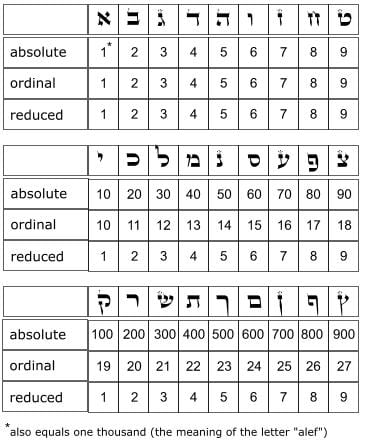
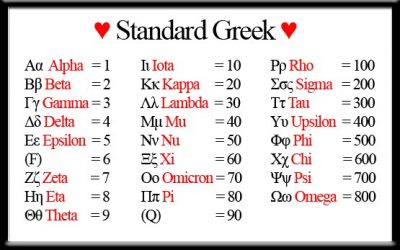
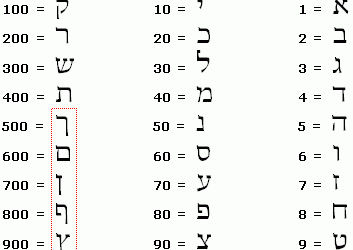
Gematria works on the premise that the letters of the alphabet can also be used as numbers, and therefore words and phrases acquire distinctive numerical values. A well known example is that of God, whose name spelt in Hebrew, is IHVH (יהוה). The values of these four letters are 10 – 5 – 6 – 5, thus the ‘number of His name’ is 26. It follows from this, by means of numerical equivalence, that God is identifiable with AHBH and AChD – Love and Unity – because the letter values of these two words sum as 1 + 5 + 2 + 5 and 1 + 8 + 4 = 26.
Gematria is said to derive from the Greek word Γεωμετρια – meaning Geometry. It may also be compounded with the word Γραμμα – meaning Writing. The reason for the geometric connection is because the rules of sacred geometry play an important part in the secondary encoding of literary cabala. Isolated numbers, such as 26, have only limited utility: they are the words of the numerical language. The sentence structure, or grammar rules, derive from number patterns which are conformed according to the properties of ‘sacred’ geometry.
We can consider, for example, a Vesica Piscis – one of the most important figures in sacred geometry. A vesica with a width of 26 – IHVH (the Creator), has a height of 45, which is the gematria value of the man he created ADM – Adam. The difference between God and man is 45 – 26 = 19. This is the value of the woman created as a companion for Adam, ChVH – ‘Eve’. In this way the sacred vesica defines the relationship between the Creator and mankind.
God’s primal act of creation is encapsulated by the first verse of Genesis. The Hebrew words here – BRAShITh BRA ALHIM ATh HShMIM VATh HARTz – have a value of 2701. Among the many interesting properties of this number is the fact that it comprises the sum of 26 squared (676) and 45 squared (2025) – hence the combination of God and Adam. This means that the 26 by 45 rectangle enclosing the vesica of creation has a diagonal of the square root of 2701.
In addition to this, the circle within which the rectangle may be precisely drawn has a circumference of 163, and by this means can symbolise that which was created: AaVLM HZH – ‘This World’. It is also a fact that the area of the rectangle is equal to that of a square with a perimeter of 139: the value of – GN ALHIM – the Garden of Eden. Furthermore, the difference between 2025 and 676, gives the value of GN ALHIM when the final letters N and M are counted high – 1349. At the same time, the area of the rectangle is equal to that of a circle with a radius of 19 – ChVH – Eve.
There are unfathomable mysteries in the gematria of Genesis and this but a gleam from the crest of the tip of a very large iceberg.
Latest MasonCode.com Posts
Virtus Junxit Mors Non Seperabit
The Juwes
The Lost Master’s Word
William Shakespeare’s Mason Mark
The Great Seal of America
The Royal Arch
Gematria Calculations
Masonic Secrets
Shakespeare’s Sonnets – Written by Kit Marlowe
The Simple Code of English Gematria
The Crown Jewels
William Shakespeare Master Mason
The Rule of Colel
Shakespeare’s Sonnets and the Cabala
Marlowe and the Cabala
Anthony and Cleopatra
The Eye in the Sonnets
Marlowe as William Shakespeare
Kit Marlowe wrote Shakespeare’s Sonnets?
William Shakespeare’s Sonnets
Jesus Christ Master Mason
Amen – So Mote It Be
Alchemical Terms
Morals and Dogma
The Great Lights of Masonry
The Immovable Jewels
Latin & English Gematria Code
Greek Gematria Code
Hebrew Gematria Code
The Movable Jewels
Entered Apprentice
Gematria – The Missing Key
About Masonic Codes
From the pillars of Solomon’s Temple to the checkered floor patterns, the world of Freemasonry is brimming with symbols and codes. These symbols, deeply ingrained in the fabric of Masonic teachings, are often referred to as “Masonic codes.”
Decoding the Rituals
One of the key aspects of Freemasonry lies in its rituals. Masonic rituals are not merely ceremonial practices, but symbolic journeys filled with allegories and metaphors designed to encourage philosophical and moral contemplation. To assist members in learning these rituals, some Masonic bodies employ ciphered books. These books use a basic substitution code where each letter is replaced by a symbol or another letter, thus preserving the ritual’s oral tradition while providing a learning aid. It is noteworthy that these texts are purposefully incomplete, meant to be read under the guidance of a mentor, thereby safeguarding the ritual’s sanctity.
Speaking Through Symbols
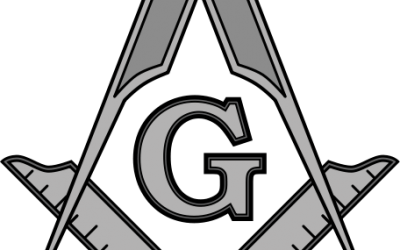
Masonic symbols serve as visual metaphors and carry profound meanings within the context of Freemasonry. The square and compasses, perhaps the most widely recognized Masonic symbol, represents virtue and wisdom. The all-seeing eye stands for divine watchfulness, and the pillar signifies strength and stability. The use of these symbols extends beyond mere representation; they serve as conduits for moral and philosophical exploration within the brotherhood.
Masonic Tokens: Silent Recognition
The concept of a “Masonic handshake” or a token is another intriguing aspect of Masonic codes. These handshakes are more than a mere greeting; they serve as a means of recognition among Freemasons, with each handshake corresponding to a different degree of Freemasonry.
Pigpen Cipher: A Glimpse into the Past
The Pigpen Cipher offers a direct look into the cryptic aspect of Masonic codes. Used by Freemasons in the 18th century, the Pigpen Cipher is a simple substitution code where each letter of the alphabet is replaced with a symbol. While this cipher isn’t in widespread use today, its existence provides fascinating insight into the history of Masonic codes.
It is crucial to understand that Masonic codes vary from one Masonic lodge and jurisdiction to another. Freemasonry, with its global presence, is a patchwork of traditions and practices shaped by cultural, historical, and regional influences. As such, the “Masonic Codes” are not uniform but rather a collection of symbolic languages reflecting the diversity within Freemasonry.
The Masonic codes serve as a unique way for Freemasons to communicate and impart moral and philosophical lessons. These codes, by virtue of their secrecy and symbolism, add an aura of mystery to Freemasonry, capturing the imagination of both members and non-members alike. As Freemasonry continues to evolve and adapt to changing times, the codes remain a testament to the order’s rich history and dedication to personal and spiritual growth.
You may be interested in the articles over at SanGraal.com.
εστιν κεκαλυμμενον ο ουκ αποκαλυφθησεται
There is nothing covered that shall not be revealed (Matthew 10,26)